New York
The EmigrantsNew York is the Charlotta’s destination and the emigrants’ first American landfall, a place whose meaning shifts from a distant promise to a real, imperfect harbor and finally to the threshold of land. The emigrants imagine fertile soil and room to build new lives, but their arrival follows an exhausting passage that has depleted both bodies and spirits; the first green shore renews their hope without yet resolving the uncertainty of what awaits them.
Destination and Expectations
The journey toward New York begins in the emigrants’ Swedish communities, where rumors and printed accounts describe a vast country with fertile land that newcomers might obtain cheaply. Yet the attraction remains largely unverified: Kristina doubts that anyone has guaranteed the family land, and she has never met a person who has seen North America. The destination is therefore powerful as an aspiration but indistinct as a lived place.
The practical arrangements turn that imagined destination into a route. Karl Oskar and Robert secure passage on the Charlotta, which is to sail directly from Karlshamn to New York without calling at another harbor. The plan is timed for an early-spring departure so the emigrants can reach their settlement in time to sow and harvest before winter. For the group from Ljuder Parish, New York is not the end of migration so much as the first named point in a longer journey toward an unknown place of settlement.
The Harbor in the Captain’s Memory
Captain Lorentz does not share the emigrants’ idealized view of the destination. He has visited New York before and remembers a town afflicted by cholera, where pigs rooted in filthy streets and many inhabitants fled inland. In his recollection, the place smelled of corpses and seemed nearly deserted. On a later visit it had become lively again, with carriages and elegantly dressed women, but he still considers it an unpleasant town for a seaman.
That recollection gives New York a history beyond the passengers’ expectations. The harbor is not a blank gateway into abundance: it is an urban place marked, in the captain’s experience, by disease, noise, dirt, and changing fortunes. As the Charlotta reaches open water, Lorentz postpones thoughts of the Hudson until the ship is actually there. His professional caution sets the destination at a practical distance from the passengers’ hopes.
The Passage and Its Constraints
The Charlotta leaves Karlshamn on April 14, 1850, carrying seventy-eight emigrants among a total of ninety-four people. Though built to carry cargo as well as passengers, the brig offers the emigrants crowded quarters: the hold is divided into small compartments by canvas, its low ceiling and thick air hemmed in by bedding, baskets, food, and bundles. The family space is full, so Karl Oskar shares a two-man bunk with Robert in the unmarried men’s section; Jonas Petter sleeps above them, and Arvid lies nearby.
Shipboard life is governed by rationing and rules rather than the freedom the emigrants associate with America. Each family receives a weekly portion of unprepared food, and passengers must take turns using the galley. They are allotted half a gallon of fresh water per person each day, must keep the hold clean, and cannot receive their water until the morning cleaning is done. The regulations also direct them to throw refuse overboard to leeward and forbid unprotected lights below deck. New York remains the distant destination, while daily survival depends on the ship’s command and limited supplies.
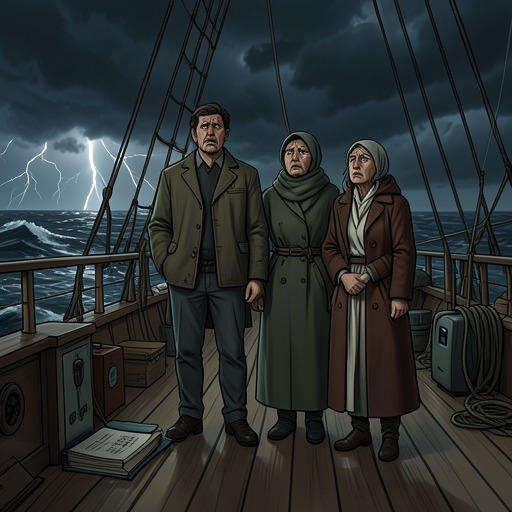
The crossing makes that dependence physical. The passengers sleep in airless quarters, endure seasickness and cold, and begin each day by scrubbing the hold and washing clothing on deck. A heavy rain offers a brief alternative source of washing water when the sailors stretch a sail to catch it. Such conditions expose the gap between the promise of land and the realities of reaching it: migration is not simply movement toward opportunity but a prolonged interval of confinement, illness, and restricted resources.
Landfall and the Green Shore
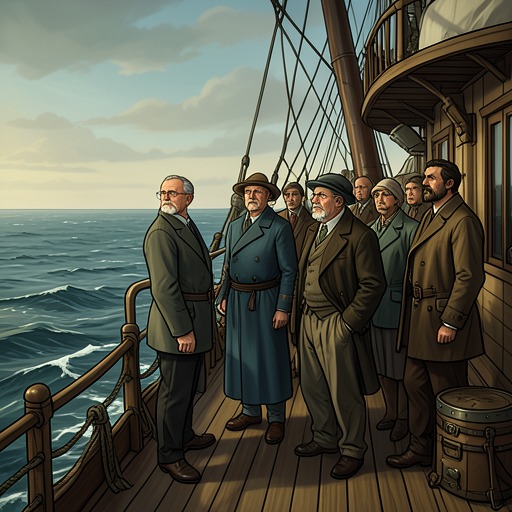
After the long voyage, the passengers crowd onto the deck as America comes into view. They see buildings, churches, roads, piers, people, and carriages, but the sight that answers their deepest anticipation is the green ground beyond the harbor: trees with thick foliage, bushes, herbs, and grass. Their gaze has been searching for living earth throughout the passage. The contrast is immediate between the dark shore they left at Karlshamn and the light, green shore now appearing before them.
The sight changes the passengers’ condition before it changes their circumstances. Storms, sickness, scurvy, ship’s fever, monotony, and confinement have weakened them, and some have grown indifferent to what life may bring. Now the visible earth restores energy: the sick hope they will recover, the weary feel strength return, and the timid regain boldness. The narrative compares the crowded passengers to cattle finally turning toward an open door after confinement through winter. New York thus marks release from the sea and renewed expectation, while the actual settlement and the work of beginning again still lie ahead.